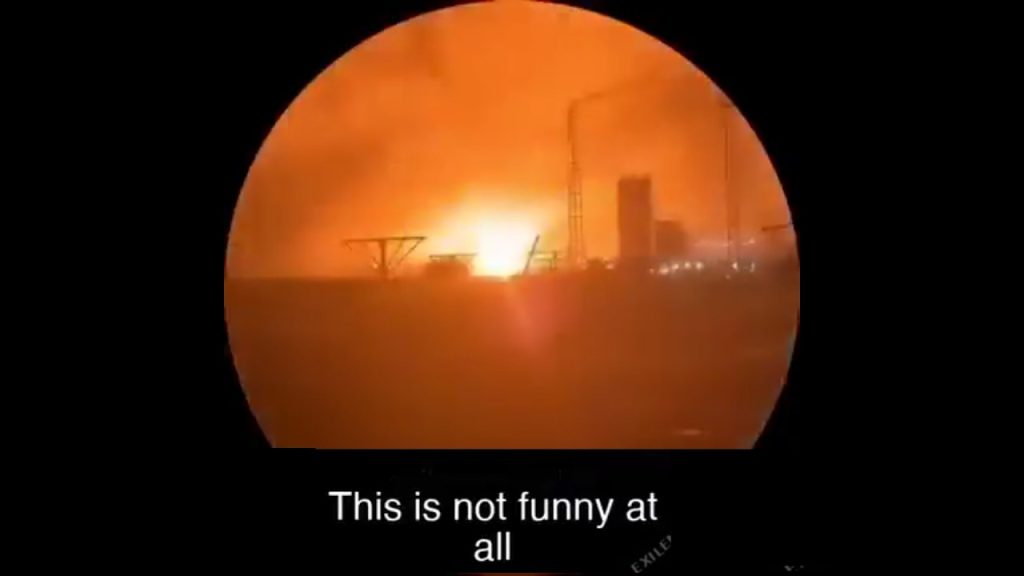
A Russian Navy missile corvette has exploded in Benghazi, Libya, in a dramatic incident captured on video and reported on 22 November 2026. The vessel has been identified as the Merkury, a Project 20380 Steregushchiy-class corvette, and the footage shows a large explosion followed by secondary cook-offs, the chain of smaller blasts that occur when ammunition and fuel catch fire after an initial blast. What caused the explosion is not yet clear from the reporting available, and there has been no mention so far of whether the ship was attacked or whether the blast was an accident. That uncertainty is central to the story, because a warship exploding in a foreign port raises very different questions depending on how it happened.
The identification of the ship comes from naval analyst H. I. Sutton, who identified the vessel in the footage as a Project 20380 corvette. The Steregushchiy class is one of the mainstays of the modern Russian Navy, a class of small, fast, heavily armed warships designed for coastal and near-shore operations. An explosion aboard such a ship, in a Libyan port far from Russia’s home waters, is a serious event in its own right, and it comes at a time when the eastern Mediterranean and North Africa are already closely watched by navies and analysts around the world. The video itself is the primary source for what happened, and it shows enough to confirm that the Merkury suffered a major, violent event, but not enough to explain it.
What the Footage Shows
The video shows the corvette in port at Benghazi when a sudden, powerful explosion erupts aboard the ship, sending fire and debris into the air. What follows is just as telling as the first blast, because a series of secondary explosions, known as cook-offs, ripples through the vessel as stored ammunition and other material ignites. Cook-offs are a familiar and feared phenomenon in naval accidents and attacks alike, because a single fire can set off one magazine after another, turning a contained incident into a ship-wide disaster. The presence of secondary cook-offs therefore suggests that the initial explosion reached the ship’s weapons or fuel, or that a fire spread quickly through spaces where explosive material was stored.
What the footage does not show, at least on its own, is the cause. There is no clear sign in the reporting of an incoming weapon, a strike, or a deliberate attack, and equally no clear sign of a specific accident, such as a fire during maintenance or a mishap with ammunition handling. That is why the original report is careful to say that there is no mention of whether it was attacked or an accident, and any honest account of the incident has to preserve that uncertainty. Warships carry large quantities of fuel, explosives, and propellants in confined spaces, so accidents, while rare, can be catastrophic, and at the same time a corvette in a contested region is a potential target. Until an official investigation or further evidence emerges, the cause remains an open question.
The Steregushchiy Class and the Merkury
The Project 20380 Steregushchiy class is a family of Russian corvettes that entered service from 2007 onward, designed to replace older Soviet-era patrol ships with a modern, stealth-shaped, multi-role warship. At about 104 metres long and displacing roughly 2,200 tonnes, a Steregushchiy-class corvette is far smaller than a frigate or a destroyer, but it is heavily armed for its size. The class typically carries Kh-35 Uran anti-ship missiles, a 100-millimetre main gun, close-in weapon systems for defence against aircraft and missiles, torpedoes, and a helicopter deck and hangar. It is built for patrol, escort, anti-submarine work, and coastal defence, and it is the kind of ship that a navy sends when it wants a visible presence without committing a large warship.
The Merkury is one of the newer ships of the class, and its presence in the Mediterranean is itself a sign of how far Russian naval operations now reach. Russia’s navy has maintained a presence in the Mediterranean for years, centred on its base at Tartus in Syria, and its ships regularly visit ports across the region. A corvette like the Merkury is well suited to that role, because it is large enough to operate far from home for extended periods, yet small enough to enter ports that could not handle a larger warship. The loss or serious damage of such a ship, even in an accident, is therefore a significant event for the Russian Navy, which has only a limited number of modern corvettes, and which has already lost major surface ships during the war in Ukraine.
Why Benghazi Matters
Benghazi is Libya’s second city and one of its most important ports, on the Mediterranean coast in the east of the country, and it has been a focal point of Libyan politics and conflict since the fall of Muammar Gaddafi in 2011. Eastern Libya is controlled by forces aligned with Khalifa Haftar, who has built close ties with Russia, and Russian military personnel and equipment have been reported in the region in recent years. A Russian warship visiting Benghazi is therefore not a random port call, but a visible sign of that relationship, and of Russia’s effort to build influence and access in North Africa. The explosion happened in that context, in a port where Russian naval visits carry political meaning as well as military purpose, and where any incident involving a Russian warship is bound to attract attention far beyond Libya.
What Is Still Unknown
For now, the most important questions about the Merkury remain unanswered. It is not known how many crew were aboard, whether there were casualties, or how badly the ship itself was damaged, and it is not known whether the vessel can be repaired or whether the explosion was severe enough to put it out of service for good. It is also not known what will happen next, whether there will be an official Russian statement, a Libyan account of the incident, or a salvage and investigation effort in Benghazi. Those details will only emerge over time, and early reporting on a fast-moving incident like this is often incomplete or contradictory. Readers should therefore treat the video as evidence of what happened, and the cause as a matter for investigation, rather than assuming an explanation before one is available.
What is clear is that a modern Russian corvette suffered a violent explosion in a Libyan port, with secondary cook-offs that suggest serious damage, and that the incident was significant enough to be identified, reported, and shared around the world within hours. Whether it turns out to have been an attack, an accident, or something else entirely, it is a reminder of how much can go wrong aboard a warship, and how quickly a routine port visit can turn into a major incident. The Merkury’s story is not finished, and the next reports, whether they come from Russia, from Libya, or from independent analysts studying the footage, will determine how this explosion is remembered. Until then, the video stands as the clearest record of a dramatic and still unexplained event in Benghazi.
Source: Suchomimus