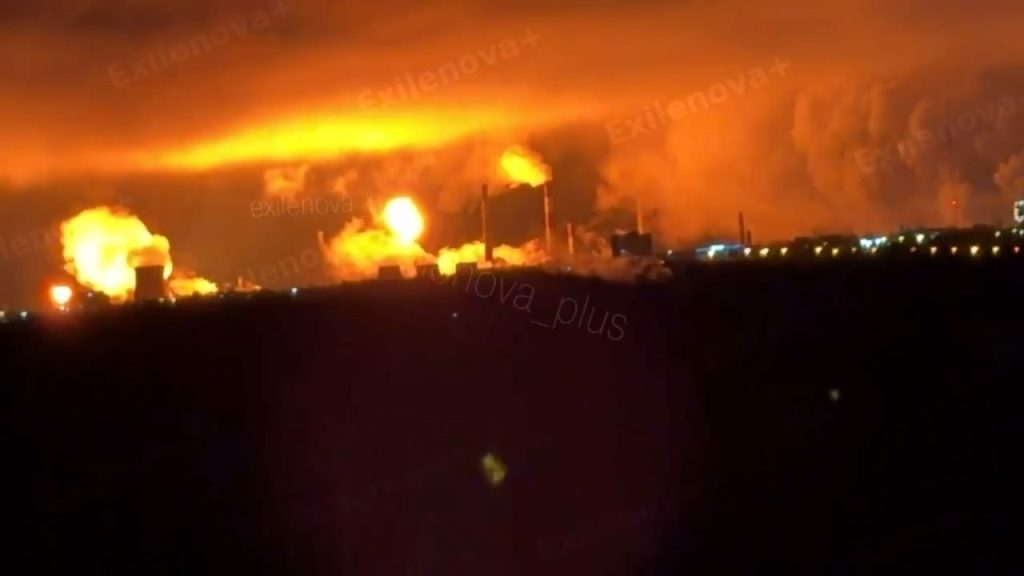
Ukrainian drones struck the Lukoil oil refinery in Volgograd overnight on November 12 into 13, in what the city’s regional governor described as the deadliest attack on Volgograd of the war so far. Governor Andrei Bocharov said four people were killed and two were injured when drones hit an industrial zone in the southern Russian city, and unverified video circulating on social media appeared to show a large fire at the refinery. Reuters reported that there was no official Russian confirmation that the refinery itself had been attacked, and Lukoil did not reply to a request for comment. The exiled Russian outlet Astra identified the burning facility as the Lukoil plant from eyewitness photographs and video. Ukraine’s military, by contrast, claimed the strike openly and in detail.
Ukraine’s General Staff said its unmanned systems units, including the 1st Separate Unmanned Systems Center and the 414th Separate Unmanned Systems Brigade, hit four primary crude distillation units and six storage tanks at the plant. Ukrainian statements described the refinery as one of the ten largest in Russia and the biggest producer of petroleum products in the country’s south. The plant processes roughly 14.8 million tonnes of crude a year, which Ukrainian officials put at about 5.6 percent of Russia’s total refining capacity. Kyiv says the refinery supplies fuel and lubricants to the Russian military, which is why it keeps coming back to the target list. The full extent of the damage, and how long any shutdown will last, has not been independently confirmed.
One Refinery, Hit Again and Again
Volgograd is not a new target; it is one of the most revisited targets of Ukraine’s refinery campaign. The plant was reported struck repeatedly through 2026, including attacks in May, July and early October, and Ukrainian monitoring groups count the November strike as at least the thirteenth or fourteenth hit on the facility since early 2024. That persistence is the strategy in miniature: a single raid rarely keeps a large refinery down for long, but repeated strikes on distillation units and tank farms force repeated shutdowns, repairs and workarounds. There are signs the plant may already have been struggling before this latest attack. Satellite heat readings analysed by one energy desk showed no thermal activity at the refinery from October 29 until the day of the strike, a pattern consistent with reporting by Reuters and Meduza that processing there had halted in early October.
The Volgograd raid also landed in the middle of the largest Ukrainian refinery offensive of the war. Ukraine has sharply stepped up its attacks on Russian refining since the end of October, after an energy ceasefire announced by U.S. President Donald Trump failed to take hold. By mid-November the Volgograd plant was at least the eighth or ninth Russian refinery struck since the start of the month. Industry sources cited by Reuters put the fall in Russian refining throughput at about 30 percent since late October, with daily crude processing dropping from roughly 700,000 tonnes to about 500,000 tonnes. Russian media and the Kyiv Post described queues at filling stations in Volgograd, shortages in at least eight regions, and purchase limits returning at some Moscow stations.
Russia’s Defence Ministry said its air defences intercepted 1,198 Ukrainian drones that night, one of the largest barrages it has ever claimed. That figure comes from Moscow alone and cannot be independently verified. It is best read as a measure of the attack’s scale as Russia wants it understood, not as a confirmed count.
Russia Answers on Ukraine’s Power Grid
The other half of this story is that Russia is running the same playbook in reverse, and at scale. While Ukraine works through Russia’s refinery list, Russian strikes keep working through Ukraine’s power stations, substations and heating infrastructure as winter approaches. Ukraine’s Energy Ministry said hourly outage schedules applied in most of the country on November 12, with capacity restrictions imposed on industrial consumers. Interfax-Ukraine reported that consumers in nine regions had no electricity at all on November 12. That is the exchange both capitals have now settled into: Kyiv trades refinery capacity and Russian drivers’ fuel against blackouts and cold in Ukrainian cities. Neither side shows any sign of blinking first, and the failed ceasefire means there is currently no agreement on the table to stop them.
What happens next at Volgograd will be told by evidence, not statements. If satellite imagery and local reporting show the fires out and the plant cold in the coming days, Ukraine will have bought itself another few weeks of reduced Russian fuel output at the price of one night’s drones. If the refinery restarts quickly, the raid joins the long list of strikes that hurt without disabling, and the plant will likely be visited again. Either way, the pattern is now firmly set for the winter: refineries are front-line targets, energy infrastructure on both sides is fair game, and a strike that kills four workers in a Russian industrial city barely pauses the news cycle before the next one is planned.
Source: Warthog Defense